
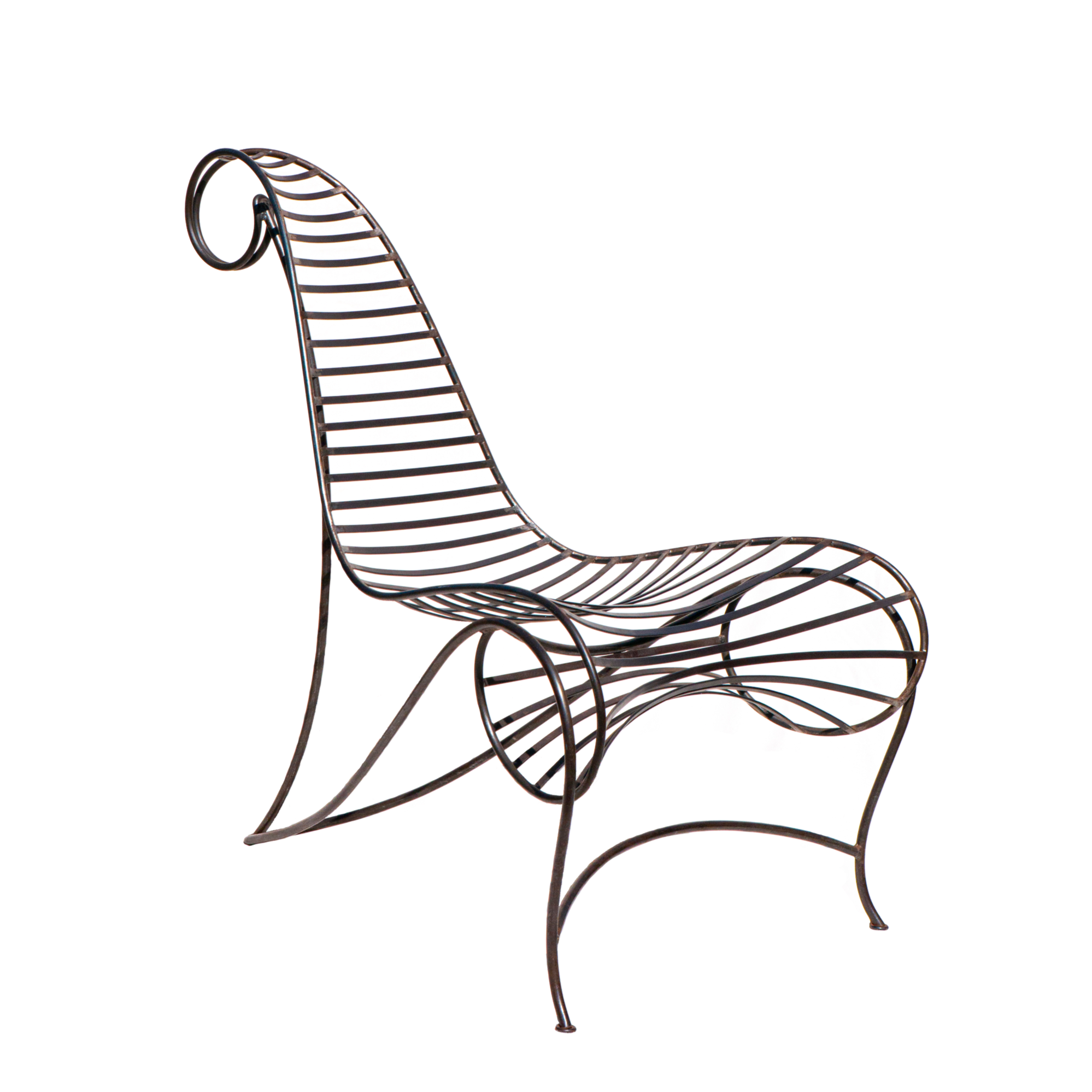
-
H. 100 cm x W. 45 cm x D. 50 cm
H. 39.4 in x W. 17.7 in x D. 19.7 in -
André Dubreuil (1951–2022) was a French artist, designer, and craftsman known for his baroque, sculptural approach to furniture design. Born in Lyon, he studied interior design in London and Paris before beginning his career in decoration and antiques. In the early 1980s, Dubreuil became involved with the "Creative Salvage" movement in London, alongside figures like Tom Dixon. It was during this period that he discovered metalwork, a turning point that led to his first iconic pieces, including the Spine Chair (1986), crafted from bent and welded steel. Rejecting minimalism, he favored ornate, evocative forms, often using salvaged materials. His work merges classical references with punk-infused irreverence, creating pieces at the intersection of sculpture and furniture. From the late 1980s, he gained international acclaim and exhibited widely. In 1992, Dubreuil returned to France, where he established a studio in the Périgord region, continuing to produce unique works until his death in 2022. Refusing mass production, Dubreuil considered himself more of an artisan than a designer, committed to the expressive potential of handmade creation.
-
Galerie Néotù,
French private collection -
Examples of this model are held in the following public collections:
Fonds National d'Art Contemporain (France),Link to object
Victoria and Albert Museum (UK)Link to object
Vitra Design Museum (Germany)Link to object
Museum of Fine Arts, Boston (USA)Link to object
Virginia Museum of Fine Arts (USA)Link to object
Brooklyn Museum (USA)Link to object
Examples of this model have been exhibited in the following exhibitions:"Design 1950–1990: Cinquante acquisitions du Fonds National d’Art Contemporain", Musée des Arts Décoratifs, Paris, France, June 15 – September 23, 1992
"Sièges de collection", Parc des Expositions de Paris, France, January 8 – January 12, 2004
"Design contre Design", Galeries Nationales du Grand Palais, Paris, France, September 26, 2007 – January 7, 2008
-
Claire Downey, Neo Furniture, Thames & Hudson, London, 1992, p. 56.
Charlotte & Peter Fiell, Modern Chairs, Taschen, Paris, 1993, p. 124.
Pierre Kjellberg, Le Mobilier du XXème Siècle, Paris, 1994, p. 181.
Charlotte & Peter Fiell, 1000 Chairs, Cologne, 1997, p. 602.
Yvonne Brunhammer & Marie-Laure Perrin, Le Mobilier Français 1960–1998, Paris, 1998, p. 43.
Jean-Louis Gaillemin, André Dubreuil poète de fer, Norma, Paris, 2006, p. 38-41.Charlotte & Peter Fiell, Modern Classics: Postwar to Postmodernism, London, 2001, p. 159.
Anne Bony, Meubles et décors des années 80, Éditions du Regard, Paris, 2010, p. 95.
-
Very good original condition.